
Day-night blinds
Sheer and solid bands in one cloth. Two settings from a single blind, where a double roller feels like one blind too many.
ExploreHome / The collection / Roller blinds
What we fit
One panel, one aluminium tube, and one decision that matters far more than the hardware: what the fabric does to the light. Get that right and the blind disappears into the room. Get it wrong and you notice it every single afternoon.
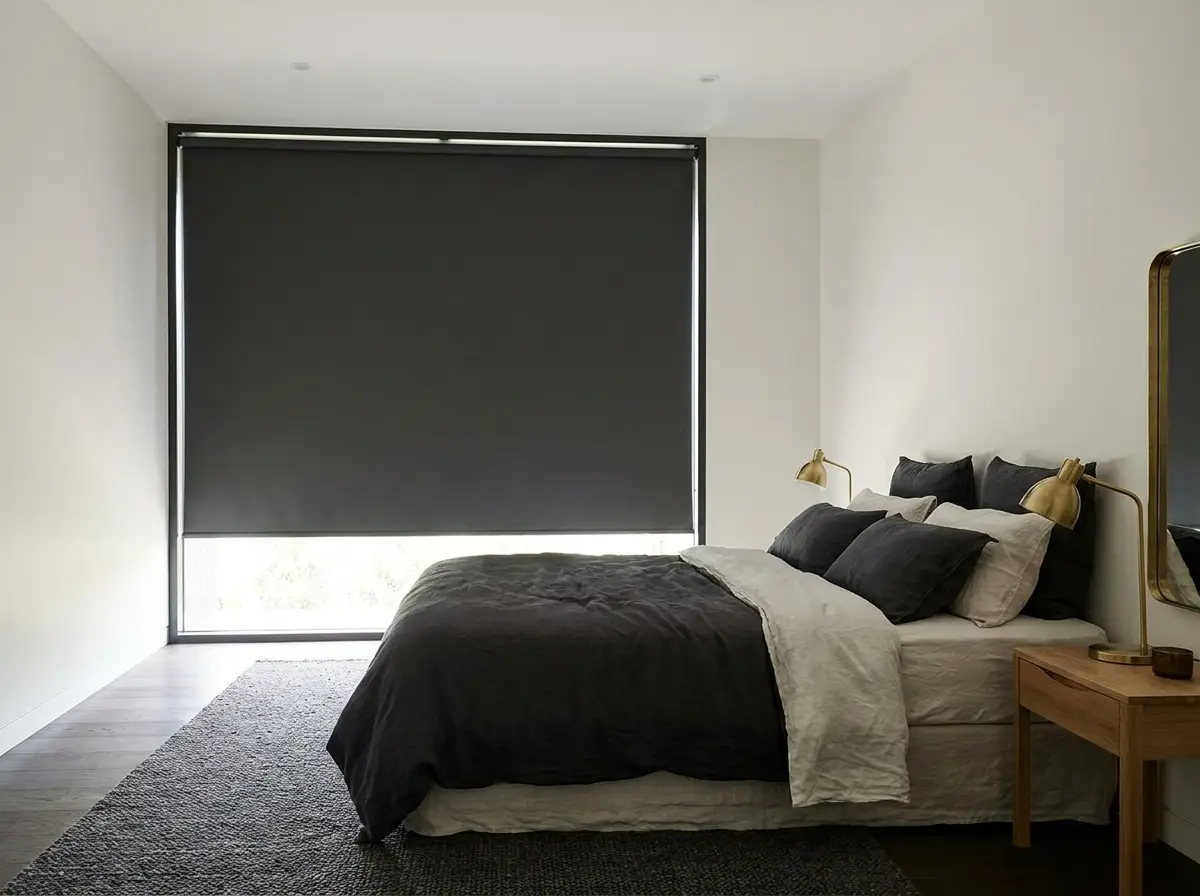
The mechanism barely changes whatever you spend on it. A tube, a bracket at either end, a control down one side. What changes the room is the fabric wound around that tube, and there are three families of it worth knowing about before a consultant arrives with a sample case.
The estate sits between the Klein Drakenstein and the Simonsberg, and a main bedroom on the eastern face of a house here catches the sun properly early — before half past five at the peak of a Boland summer. Blockout is the answer to that, and it works by its coating rather than its thickness, which is why a good one hangs light and rolls tight.
Now the limit, which we would rather you heard from us than discovered on the first hot morning. A roller has to hang a few millimetres clear of the glass so the fabric can travel, and light finds that gap: a thin bright outline down each side of the blind. Nearly dark. Not dark.
Where dark has to mean dark, we run the fabric inside slim aluminium channels fixed down each reveal, and the outline goes. It costs more and it adds time to the installation. In a main bedroom, a nursery or a media room it is the upgrade people are gladdest they took.
Sunscreen is a woven mesh, and the figure on the sample tag — its openness factor — is simply how much of the weave is hole rather than yarn. That one number settles both what you keep and what you give up.
Colour pulls the opposite way to most people’s instinct. A pale mesh bounces heat back out through the glass but washes the view pale along with it; a charcoal mesh gives an almost photographic outlook and absorbs more of that heat itself. We hold both against your own window at the hour that bothers you, and the decision tends to make itself in about ten seconds.
The stack doors that open a living room onto the stoep are often three to four metres of glass in a single run. A roller will cover that, but the tube has to be sized for the span. Put too slim a tube across too wide an opening and the middle sags a fraction, the fabric starts tracking to one side, and the whole thing looks tired inside a season.
Two honest ways round it. Either a heavier tube with the fabric matched to the width, or the run split into two or three blinds sitting shoulder to shoulder under one head and linked to move together on a single motor. Past roughly three metres the split is usually the better blind, and we will say so at the measure rather than quietly sell you the wider one.
Where a room has to do both jobs properly, a double roller carries a mesh and a blockout on the same bracket: sunscreen down through the day, blockout down at night. If the thought of two blinds in one reveal does not appeal, a day-night blind reaches the same place from the other direction: one cloth woven in bands, sheer against solid, the two layers stepping over one another as the tube turns.
Three controls, and only three. A side chain, a spring mechanism you pull and release, or a tube motor. Every chain we hang is tensioned and screwed back to the wall as standard — not on request, not as a line item. In a nursery, a playroom or at any window a child can reach, we will steer you towards a motor or a cordless spring instead, so there is nothing hanging there at all.
A roller asks very little of you afterwards. A damp cloth down the face two or three times a year, a soft brush across a mesh, and that is the maintenance. What ages a blind in this valley is ultraviolet: a west-facing fabric works considerably harder than the same cloth on a south wall and will show it first. That is the argument for specifying a fabric rated for the elevation rather than the cheapest roll in the book — and we quote the fabric manufacturer’s own written warranty rather than inventing a number of our own.
Often specified alongside
Sheer and solid bands in one cloth. Two settings from a single blind, where a double roller feels like one blind too many.
ExploreWhen the complaint is heat rather than light, the work has to happen outside the pane. Tilting aluminium slats do it.
ExploreWhat puts three linked rollers across a stack door onto one button, and what gets a chain out of a stairwell.
ExploreWhere we fit it
More rollers leave our workroom than anything else on the list — for Val de Vie and Pearl Valley first, and for the farmhouses, guest suites and village cottages around them.
Before you order
No, and anyone who says otherwise has not stood outside the house at night. A mesh works on the brightness difference between the two sides of the glass, so it reverses the moment the lamps go on: you see less out, and someone on the path sees more in. Where a room is overlooked — a ground-floor bedroom near a walkway, a bathroom facing a neighbouring stand — we either put a blockout behind the mesh on a double bracket or point you at a day-night blind instead.
Inside looks built in, and it needs a reveal deep enough to swallow the tube plus the fabric wound around it. Face-fixed sits proud of the opening, covers the frame and cuts a good deal more edge light, which is why blockout bedrooms so often end up face-fixed. It also forgives an opening that is not quite square — and in the older plastered houses around Paarl and Simondium, very few of them are. The consultant checks both at the measure and tells you which the window is actually asking for.
It helps, but less than people hope. Once the sun has crossed the pane the heat is already inside and the glass itself is warm; a blockout stops the light and some radiant heat after that fact. If the complaint is a January afternoon rather than a summer sunrise, the first money is better spent outside the glass — an external venetian, a shutter or a screen — and the roller then finishes the job on light and privacy.
Yes, with two things thought about first. The blind has to clear the handle, so on a hinged door we either bracket it out on spacers or specify a bottom bar that will not catch. And the control goes on the side nobody walks through, which sounds obvious until a chain has hung on the traffic side for three years. On a wide stack door, motorising it removes the question altogether.
Usually. Staple ranges run for years, though fabric books do get discontinued and we will not promise a colour will still exist. What we can do is record the exact fabric name, colour and roll width on your quote, so there is a proper reference to work from later. In most cases a single damaged blind is re-covered on its original tube and brackets, which costs considerably less than starting again.
Guide figures, per square metre, installed. A hand-operated roller in blockout, sunscreen or a light-filtering fabric works out at R1,000 to R1,600 per square metre; a plain blockout sits at the foot of that band, a premium mesh or a double bracket carrying two fabrics at the head of it. With a motor in the tube, the same window comes in at R2,500 to R3,800 per square metre.
Small windows carry a minimum charge, because the tube, the brackets and the fitting time hardly change with width. Take the band as orientation only. Everything here is made to measure, so the honest number for your own openings comes out of the free measure and arrives itemised, one line per window.
Next step
Tell us which rooms are the problem and roughly how many windows. A consultant brings the blockout and mesh samples out to you, reads the light at the hour it actually bothers you, and leaves you with a price per window. One of our expert consultants will contact you shortly.