
Home / The collection / Motorisation
What we fit
Motorised blinds & automation
Tubular motors inside the roll, run from a remote, a wall switch, a phone or a sensor. On the wide, high and external glass that estate homes here tend to have, it stops being a luxury and starts being the only practical option.
Power: battery or wired
Rechargeable battery motors need no wiring at all, so they suit a retrofit on a blind that already exists — charge it every few months from a USB-style charger and forget about it. Wired 220V motors suit a new build or a renovation, where power can reach the head of the window while things are still open; they are the better fit for big or heavy systems and for anything living outside, like an external venetian or a roller shutter.
Control, sold by lifestyle rather than spec sheet
- Remote — a single handset can run every blind in a room, or the whole house.
- App — close the west blinds from the golf course, or check you didn’t leave the tasting-deck shading up before a storm rolls over the mountains.
- Schedule — the main bedroom opens with sunrise, the vineyard-facing living room drops its sunscreen at four every summer afternoon, whether anyone is home or not.
- Sensors — a sun sensor closes exposed shading automatically; a wind sensor retracts an awning or a screen before a gust gets a chance to damage it. Non-negotiable on anything living outside.
Where it is close to essential
Spans too wide or heavy for a chain, blinds above stair voids and double-volume glass, concealed ceiling-recess systems, and every external product — venetians, roller shutters, awnings, zip screens. If a house has been away for a week over polo season, a scheduled and sensor-protected system is doing quiet work the whole time it is empty.
The honest trade-offs
Motorisation adds a premium per blind, though it scales well once several blinds share one remote or app. Battery motors need that periodic charge — we set the expectation at quote stage rather than let it be a surprise. And no dangling chain is, incidentally, the most child-safe control there is: nothing hangs within reach at all.
Often specified alongside
Also worth looking at
Concealed blind boxes
Fabric from a slot in the ceiling — almost always motorised, since there is nothing to reach for by hand.
ExploreRoller blinds
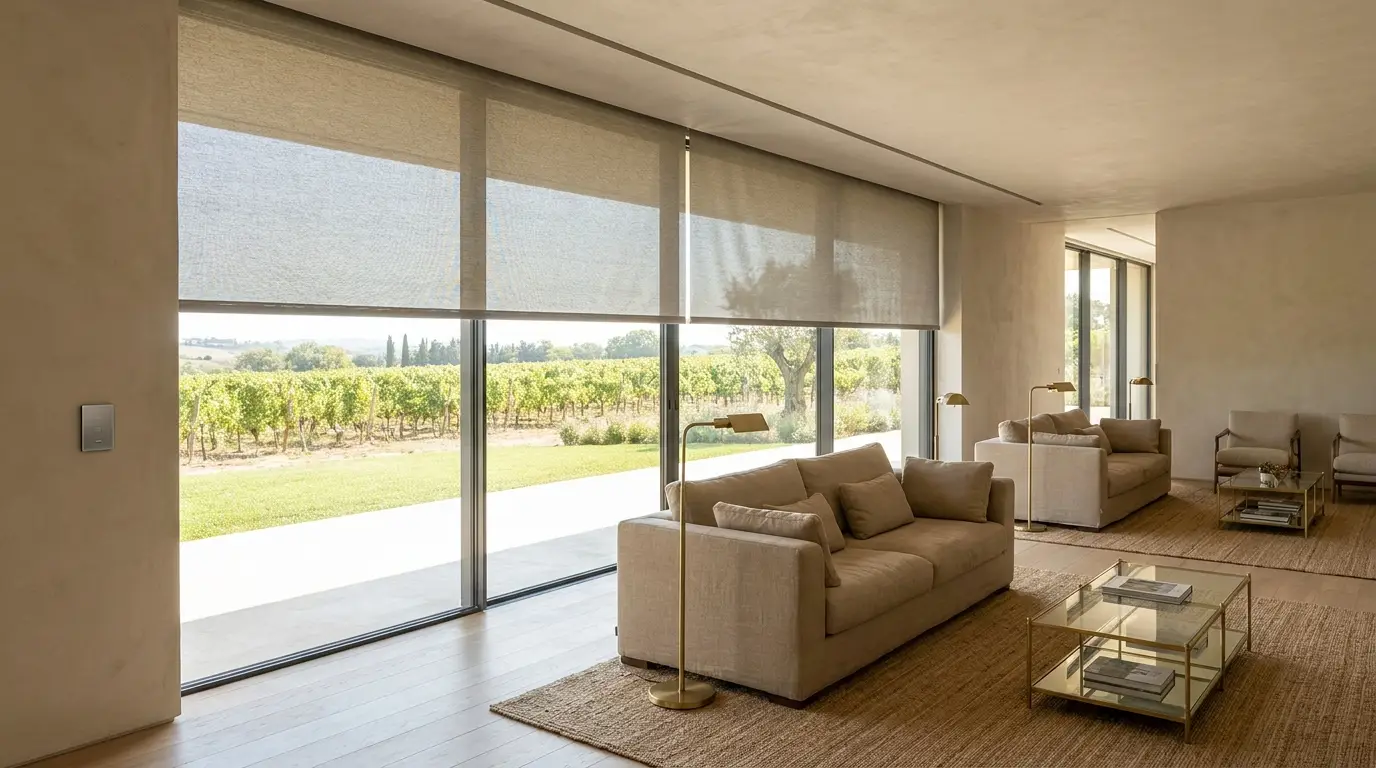
Wide vineyard-view stack doors are usually motorised so the whole run moves together.
ExploreWhere we fit it
Motorisation is close to the default across Val de Vie and Pearl Valley’s larger glazed homes, and increasingly requested in Paarl, Franschhoek, Simondium and Groot Drakenstein too.
What motorisation adds, product by product
Motorisation is priced by the thing it drives, so the answer is a spread rather than a figure: roughly R2,500 to R7,500 per square metre installed across the collection. A motorised blockout or sunscreen roller lands at R2,500 to R3,800 per square metre; a motorised day-night blind at R2,800 to R4,000; motorised external venetians at R4,500 to R6,500.
Read those as guide bands per square metre installed rather than as prices, and note that small windows still carry a minimum charge. What moves the number in practice is the room: how many blinds share a control, whether a battery tube or a wired motor suits the wall, and how far the power is from the opening. All three are settled at the free measure, with the itemised price to follow.
Next step
Get a written quote for a motorised system
A free in-home measure, a walkthrough of remote, app, schedule and sensor options, and a written quote itemised per opening. One of our expert consultants will contact you shortly.