
Roller blinds
One flat panel on a tube. Blockout for the main bedroom, sunscreen mesh to keep the view.
ExploreHome / The collection / Day-night blinds
What we fit
Alternating sheer and solid bands on a continuous loop. Align them and the vine rows stay in soft view; offset them and the room goes to near-solid privacy — one blind, two moods, no second fabric to buy.
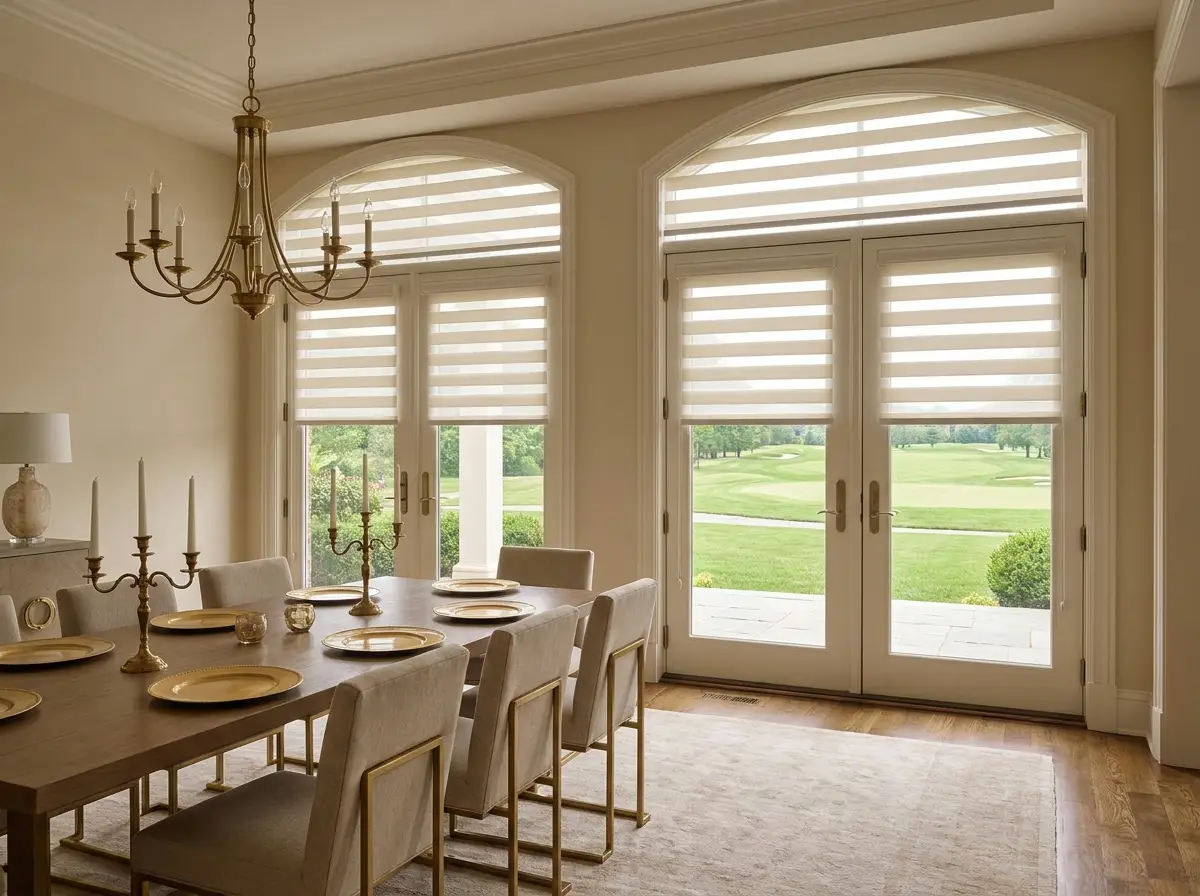
A day-night blind — also called a zebra or vision blind — runs two fabric bands, one sheer and one more solid, on a single loop. Slide the loop one way and the bands align, giving a softly filtered, privacy-with-view daytime look across the vine rows. Slide it the other way and the solid bands overlap, blocking sightlines from outside almost completely once the lights are on.
It is the fabric we reach for most often on this estate for main bedrooms with a vineyard or fairway outlook, where a plain sunscreen would feel too exposed after dark and a plain blockout would waste the view all day.
Even fully offset, a day-night blind is not a true blockout — a little light finds its way along the band edges, which matters in a nursery or a shift-worker’s room more than a main bedroom. Where genuine darkness is the brief, we pair it with a blockout roller on a second bracket, or recommend the roller alone.
The sheer bands are also more delicate than a plain roller fabric, so in a playroom or anywhere small hands and paws reach the fabric, we will usually steer you toward a standard roller instead.
Standard roller hardware underneath: chain (tensioned and wall-anchored as standard) or motorised, in a cassette or open-roll finish, inside or outside the reveal. On a main bedroom we will usually recommend motorising it, so nothing hangs within reach of a bed.
Often specified alongside
One flat panel on a tube. Blockout for the main bedroom, sunscreen mesh to keep the view.
ExploreAir trapped in a honeycomb weave — the best-insulating fabric blind we fit.
ExploreWhere we fit it
Day-night blinds are the standard main-bedroom pick across Val de Vie and Pearl Valley, and go down just as well in Paarl, Franschhoek, Simondium and Groot Drakenstein.
There is roughly twice the fabric on a day-night tube as on a plain roller, and the guide follows from it: R1,300 to R2,000 per square metre installed for a chain-operated blind, and R2,800 to R4,000 motorised. Wider banding, a cassette over the roll and a semi-blockout backing each carry a window nearer the upper figure.
A narrow window still carries a minimum charge, since the hardware and the labour do not shrink with the fabric. Which rooms actually want banding rather than a plain roller is a question for the measure, and the written price per window follows that visit.
Next step
A free in-home measure, samples in your own light, and a written quote itemised per window. One of our expert consultants will contact you shortly.